 PokePilot
 Analysis Examples
This example starts with Kabamanda: Hippowdon setting the stage for Mega Salamence. We ran the team through PokePilot to look at individual roles, possible bring-three lineups, and a choice for the last slot.
Practical guide: Hippowdon's Defense and Special Defense investment
1. The team
The core is Hippowdon and Mega Salamence, backed by Mega Lucario Z, Archaludon, and Meowscarada. We left Primarina out of the original roster to see what PokePilot would suggest as a sixth member.
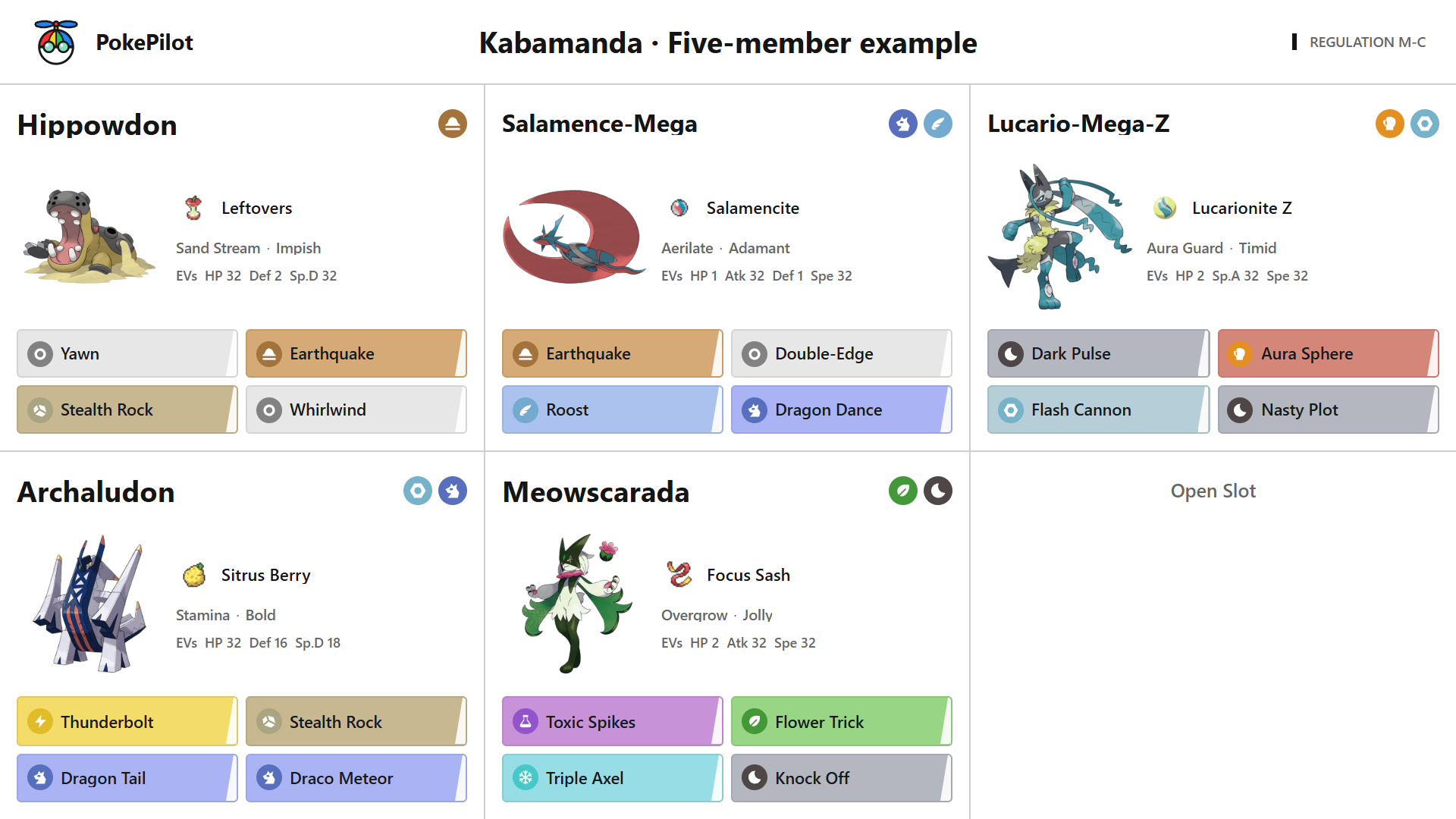
Team source: Game8’s Kabamanda team, with Primarina removed.
2. Hippowdon’s role
We started with Hippowdon. The Pokemon analysis picks out its job: get Stealth Rock up, then use Yawn and Whirlwind to pressure switches and create openings for the attackers.
It also flags the interaction with Meowscarada. Sand chip can break Focus Sash, so bringing both means paying attention to when Meowscarada takes the field and how many sand turns remain.
Hippowdon
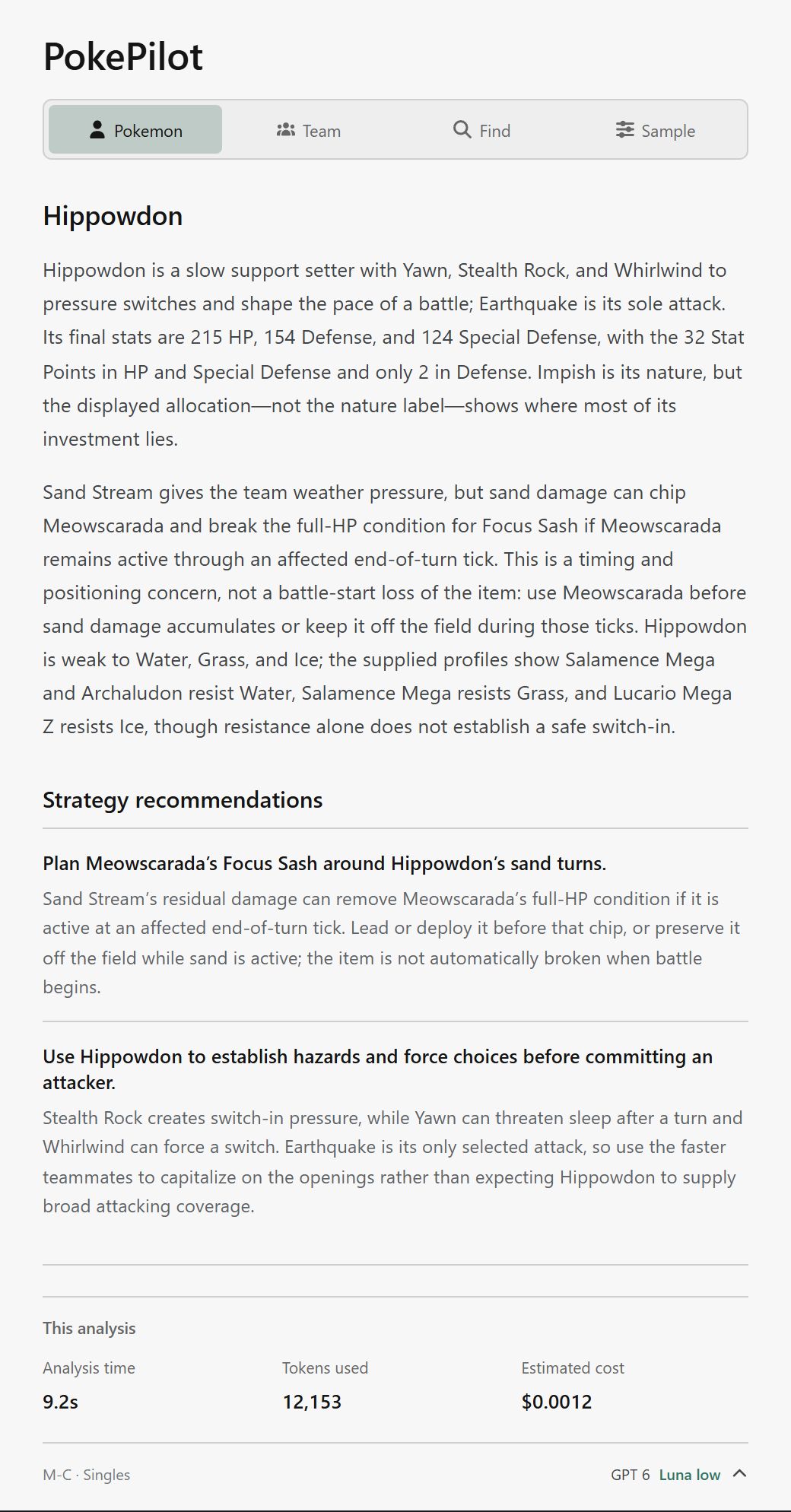
Hippowdon is a slow support setter with Yawn, Stealth Rock, and Whirlwind to pressure switches and shape the pace of a battle; Earthquake is its sole attack. Its final stats are 215 HP, 154 Defense, and 124 Special Defense, with the 32 Stat Points in HP and Special Defense and only 2 in Defense. Impish is its nature, but the displayed allocation—not the nature label—shows where most of its investment lies.
Sand Stream gives the team weather pressure, but sand damage can chip Meowscarada and break the full-HP condition for Focus Sash if Meowscarada remains active through an affected end-of-turn tick. This is a timing and positioning concern, not a battle-start loss of the item: use Meowscarada before sand damage accumulates or keep it off the field during those ticks. Hippowdon is weak to Water, Grass, and Ice; the supplied profiles show Salamence Mega and Archaludon resist Water, Salamence Mega resists Grass, and Lucario Mega Z resists Ice, though resistance alone does not establish a safe switch-in.
Plan Meowscarada’s Focus Sash around Hippowdon’s sand turns.
Sand Stream’s residual damage can remove Meowscarada’s full-HP condition if it is active at an affected end-of-turn tick. Lead or deploy it before that chip, or preserve it off the field while sand is active; the item is not automatically broken when battle begins.
Use Hippowdon to establish hazards and force choices before committing an attacker.
Stealth Rock creates switch-in pressure, while Yawn can threaten sleep after a turn and Whirlwind can force a switch. Earthquake is its only selected attack, so use the faster teammates to capitalize on the openings rather than expecting Hippowdon to supply broad attacking coverage.
Time: 9.2s · Total tokens: 12,153 · Estimated cost: $0.00122
3. The game plan
The team analysis offers two bring-three lineups: Hippowdon and Meowscarada alongside either Mega Salamence or Mega Lucario Z. Salamence supplies Dragon Dance and physical pressure; Lucario Z offers Nasty Plot and special attacks.
Both lineups use Hippowdon’s hazards and disruption. Lucario Z avoids sand damage thanks to its Steel typing, but Meowscarada does not: if sand chips it at the end of a turn, Focus Sash loses its full-HP condition.
Kabamanda
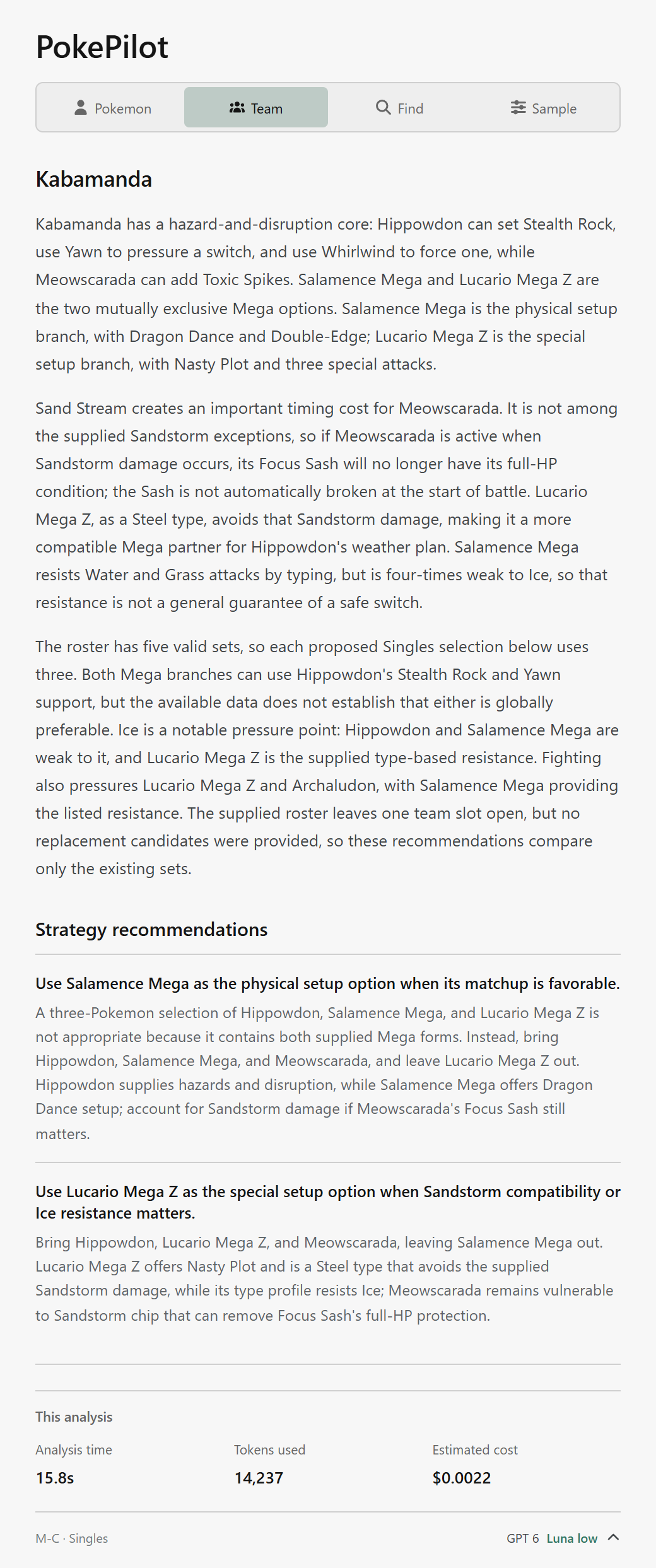
Kabamanda has a hazard-and-disruption core: Hippowdon can set Stealth Rock, use Yawn to pressure a switch, and use Whirlwind to force one, while Meowscarada can add Toxic Spikes. Salamence Mega and Lucario Mega Z are the two mutually exclusive Mega options. Salamence Mega is the physical setup branch, with Dragon Dance and Double-Edge; Lucario Mega Z is the special setup branch, with Nasty Plot and three special attacks.
Sand Stream creates an important timing cost for Meowscarada. It is not among the supplied Sandstorm exceptions, so if Meowscarada is active when Sandstorm damage occurs, its Focus Sash will no longer have its full-HP condition; the Sash is not automatically broken at the start of battle. Lucario Mega Z, as a Steel type, avoids that Sandstorm damage, making it a more compatible Mega partner for Hippowdon's weather plan. Salamence Mega resists Water and Grass attacks by typing, but is four-times weak to Ice, so that resistance is not a general guarantee of a safe switch.
The roster has five valid sets, so each proposed Singles selection below uses three. Both Mega branches can use Hippowdon's Stealth Rock and Yawn support, but the available data does not establish that either is globally preferable. Ice is a notable pressure point: Hippowdon and Salamence Mega are weak to it, and Lucario Mega Z is the supplied type-based resistance. Fighting also pressures Lucario Mega Z and Archaludon, with Salamence Mega providing the listed resistance. The supplied roster leaves one team slot open, but no replacement candidates were provided, so these recommendations compare only the existing sets.
Use Salamence Mega as the physical setup option when its matchup is favorable.
A three-Pokemon selection of Hippowdon, Salamence Mega, and Lucario Mega Z is not appropriate because it contains both supplied Mega forms. Instead, bring Hippowdon, Salamence Mega, and Meowscarada, and leave Lucario Mega Z out. Hippowdon supplies hazards and disruption, while Salamence Mega offers Dragon Dance setup; account for Sandstorm damage if Meowscarada's Focus Sash still matters.
Use Lucario Mega Z as the special setup option when Sandstorm compatibility or Ice resistance matters.
Bring Hippowdon, Lucario Mega Z, and Meowscarada, leaving Salamence Mega out. Lucario Mega Z offers Nasty Plot and is a Steel type that avoids the supplied Sandstorm damage, while its type profile resists Ice; Meowscarada remains vulnerable to Sandstorm chip that can remove Focus Sash's full-HP protection.
Time: 15.8s · Total tokens: 14,237 · Estimated cost: $0.00220
4. Filling the last slot
With a slot open, we asked for a sixth member. Primarina came first for Encore, special offense, and its Fire, Ice, and Fighting resistances. The result also points out the tradeoff: it is slow and weak to Electric.
Gyarados offers Intimidate and Taunt but adds another physical attacker. Rotom-Wash supplies Volt Switch and a Ground immunity, though Grass remains a concern. The candidates fill different roles rather than solving every matchup.
Kabamanda
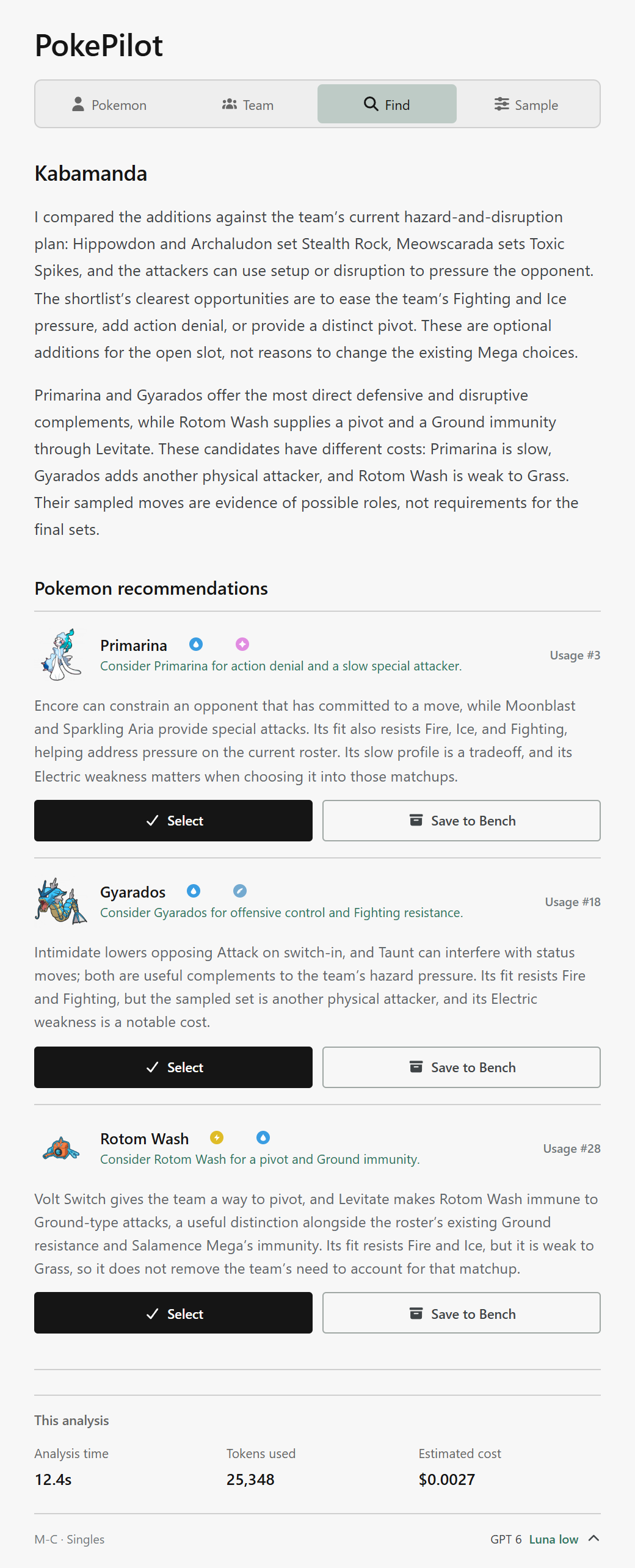
I compared the additions against the team’s current hazard-and-disruption plan: Hippowdon and Archaludon set Stealth Rock, Meowscarada sets Toxic Spikes, and the attackers can use setup or disruption to pressure the opponent. The shortlist’s clearest opportunities are to ease the team’s Fighting and Ice pressure, add action denial, or provide a distinct pivot. These are optional additions for the open slot, not reasons to change the existing Mega choices.
Primarina and Gyarados offer the most direct defensive and disruptive complements, while Rotom Wash supplies a pivot and a Ground immunity through Levitate. These candidates have different costs: Primarina is slow, Gyarados adds another physical attacker, and Rotom Wash is weak to Grass. Their sampled moves are evidence of possible roles, not requirements for the final sets.
Consider Primarina for action denial and a slow special attacker.
Encore can constrain an opponent that has committed to a move, while Moonblast and Sparkling Aria provide special attacks. Its fit also resists Fire, Ice, and Fighting, helping address pressure on the current roster. Its slow profile is a tradeoff, and its Electric weakness matters when choosing it into those matchups.
Consider Gyarados for offensive control and Fighting resistance.
Intimidate lowers opposing Attack on switch-in, and Taunt can interfere with status moves; both are useful complements to the team’s hazard pressure. Its fit resists Fire and Fighting, but the sampled set is another physical attacker, and its Electric weakness is a notable cost.
Consider Rotom Wash for a pivot and Ground immunity.
Volt Switch gives the team a way to pivot, and Levitate makes Rotom Wash immune to Ground-type attacks, a useful distinction alongside the roster’s existing Ground resistance and Salamence Mega’s immunity. Its fit resists Fire and Ice, but it is weak to Grass, so it does not remove the team’s need to account for that matchup.
Time: 12.4s · Total tokens: 25,348 · Estimated cost: $0.00268
5. Tuning Salamence’s set
Starting without a spread
For the set recommendation, we reset Mega Salamence to Hardy with no Stat Points invested, leaving its item and moves alone.
PokePilot suggested Adamant with Attack and Speed investment. It kept Dragon Dance, Earthquake, Double-Edge, and Roost, staying with the physical setup role rather than changing the moveset.
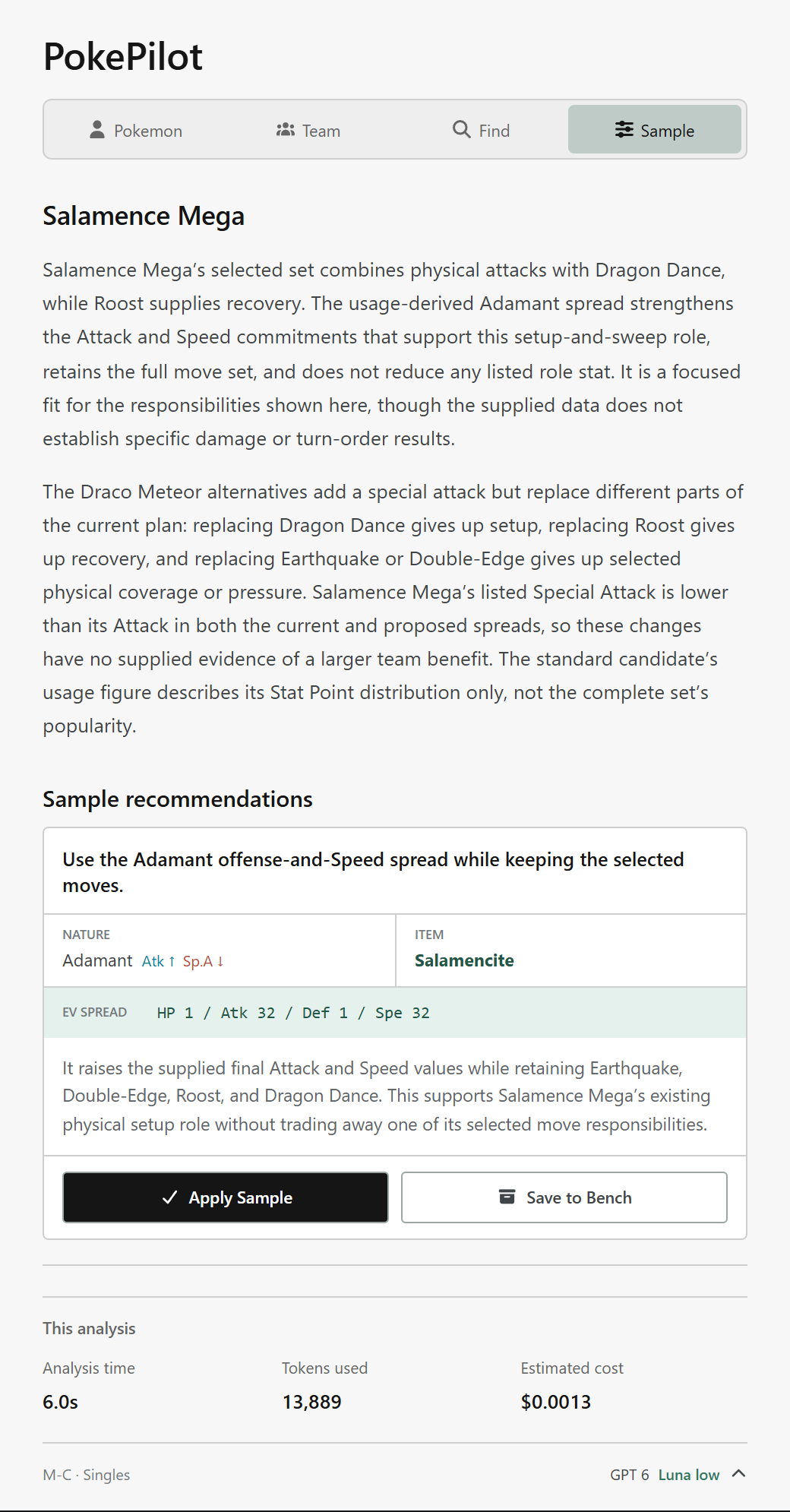
Salamence Mega
Salamence Mega’s selected set combines physical attacks with Dragon Dance, while Roost supplies recovery. The usage-derived Adamant spread strengthens the Attack and Speed commitments that support this setup-and-sweep role, retains the full move set, and does not reduce any listed role stat. It is a focused fit for the responsibilities shown here, though the supplied data does not establish specific damage or turn-order results.
The Draco Meteor alternatives add a special attack but replace different parts of the current plan: replacing Dragon Dance gives up setup, replacing Roost gives up recovery, and replacing Earthquake or Double-Edge gives up selected physical coverage or pressure. Salamence Mega’s listed Special Attack is lower than its Attack in both the current and proposed spreads, so these changes have no supplied evidence of a larger team benefit. The standard candidate’s usage figure describes its Stat Point distribution only, not the complete set’s popularity.
Use the Adamant offense-and-Speed spread while keeping the selected moves.
It raises the supplied final Attack and Speed values while retaining Earthquake, Double-Edge, Roost, and Dragon Dance. This supports Salamence Mega’s existing physical setup role without trading away one of its selected move responsibilities.
Adamant · Salamencite
Stat Points: HP 1, Attack 32, Defense 1, Special Attack 0, Special Defense 0, Speed 32
Time: 6.0s · Total tokens: 13,889 · Estimated cost: $0.00126
Keeping a set that already fits
With the original Adamant Attack-and-Speed spread back in place, keeping the current set was the main recommendation. The Draco Meteor alternatives each gave up a useful move without adding Special Attack investment.
It also offered a minor alternative: one more point of final HP for one less point of Defense, with Attack, Speed, and all four moves unchanged. The result treats this as a preference, not an upgrade.
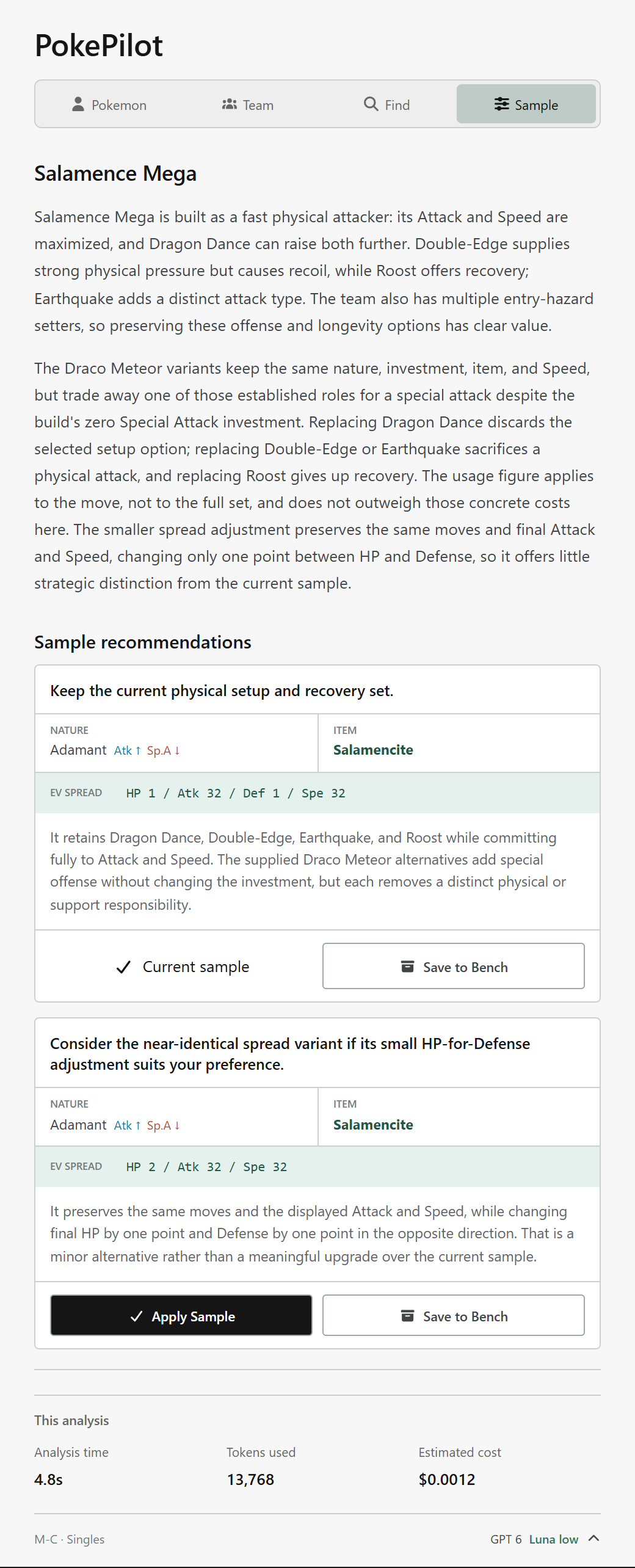
Salamence Mega
Salamence Mega is built as a fast physical attacker: its Attack and Speed are maximized, and Dragon Dance can raise both further. Double-Edge supplies strong physical pressure but causes recoil, while Roost offers recovery; Earthquake adds a distinct attack type. The team also has multiple entry-hazard setters, so preserving these offense and longevity options has clear value.
The Draco Meteor variants keep the same nature, investment, item, and Speed, but trade away one of those established roles for a special attack despite the build's zero Special Attack investment. Replacing Dragon Dance discards the selected setup option; replacing Double-Edge or Earthquake sacrifices a physical attack, and replacing Roost gives up recovery. The usage figure applies to the move, not to the full set, and does not outweigh those concrete costs here. The smaller spread adjustment preserves the same moves and final Attack and Speed, changing only one point between HP and Defense, so it offers little strategic distinction from the current sample.
Keep the current physical setup and recovery set.
It retains Dragon Dance, Double-Edge, Earthquake, and Roost while committing fully to Attack and Speed. The supplied Draco Meteor alternatives add special offense without changing the investment, but each removes a distinct physical or support responsibility.
Adamant · Salamencite
Stat Points: HP 1, Attack 32, Defense 1, Special Attack 0, Special Defense 0, Speed 32
Consider the near-identical spread variant if its small HP-for-Defense adjustment suits your preference.
It preserves the same moves and the displayed Attack and Speed, while changing final HP by one point and Defense by one point in the opposite direction. That is a minor alternative rather than a meaningful upgrade over the current sample.
Adamant · Salamencite
Stat Points: HP 2, Attack 32, Defense 0, Special Attack 0, Special Defense 0, Speed 32
Time: 4.8s · Total tokens: 13,768 · Estimated cost: $0.00120
6. Luna low vs. medium
We ran the same team at both reasoning levels. Below are low’s Salamence lineup and medium’s comparison of its two Mega lineups.
Luna low
Enlarge imageA three-Pokemon selection of Hippowdon, Salamence Mega, and Lucario Mega Z is not appropriate because it contains both supplied Mega forms. Instead, bring Hippowdon, Salamence Mega, and Meowscarada, and leave Lucario Mega Z out. Hippowdon supplies hazards and disruption, while Salamence Mega offers Dragon Dance setup; account for Sandstorm damage if Meowscarada's Focus Sash still matters.
Kabamanda
Kabamanda has a hazard-and-disruption core: Hippowdon can set Stealth Rock, use Yawn to pressure a switch, and use Whirlwind to force one, while Meowscarada can add Toxic Spikes. Salamence Mega and Lucario Mega Z are the two mutually exclusive Mega options. Salamence Mega is the physical setup branch, with Dragon Dance and Double-Edge; Lucario Mega Z is the special setup branch, with Nasty Plot and three special attacks.
Sand Stream creates an important timing cost for Meowscarada. It is not among the supplied Sandstorm exceptions, so if Meowscarada is active when Sandstorm damage occurs, its Focus Sash will no longer have its full-HP condition; the Sash is not automatically broken at the start of battle. Lucario Mega Z, as a Steel type, avoids that Sandstorm damage, making it a more compatible Mega partner for Hippowdon's weather plan. Salamence Mega resists Water and Grass attacks by typing, but is four-times weak to Ice, so that resistance is not a general guarantee of a safe switch.
The roster has five valid sets, so each proposed Singles selection below uses three. Both Mega branches can use Hippowdon's Stealth Rock and Yawn support, but the available data does not establish that either is globally preferable. Ice is a notable pressure point: Hippowdon and Salamence Mega are weak to it, and Lucario Mega Z is the supplied type-based resistance. Fighting also pressures Lucario Mega Z and Archaludon, with Salamence Mega providing the listed resistance. The supplied roster leaves one team slot open, but no replacement candidates were provided, so these recommendations compare only the existing sets.
Use Salamence Mega as the physical setup option when its matchup is favorable.
A three-Pokemon selection of Hippowdon, Salamence Mega, and Lucario Mega Z is not appropriate because it contains both supplied Mega forms. Instead, bring Hippowdon, Salamence Mega, and Meowscarada, and leave Lucario Mega Z out. Hippowdon supplies hazards and disruption, while Salamence Mega offers Dragon Dance setup; account for Sandstorm damage if Meowscarada's Focus Sash still matters.
Use Lucario Mega Z as the special setup option when Sandstorm compatibility or Ice resistance matters.
Bring Hippowdon, Lucario Mega Z, and Meowscarada, leaving Salamence Mega out. Lucario Mega Z offers Nasty Plot and is a Steel type that avoids the supplied Sandstorm damage, while its type profile resists Ice; Meowscarada remains vulnerable to Sandstorm chip that can remove Focus Sash's full-HP protection.
Time: 15.8s · Total tokens: 14,237 · Estimated cost: $0.00220
Luna medium
Enlarge imageUse Hippowdon, Salamence Mega, and Meowscarada when Dragon Dance physical pressure and Salamence Mega’s Fighting resistance fit the matchup, while accounting for its 4× Ice weakness. Use Hippowdon, Lucario Mega Z, and Meowscarada when special pressure and an Ice resistance are more useful; this choice gives up Salamence Mega’s physical setup and Fighting resistance. Do not combine the two supplied Mega forms in the same selection without base-form evidence.
Kabamanda
Kabamanda is best approached as a hazard-and-switch-pressure team with a flexible three-Pokémon selection, not as a dedicated Sand mode: the supplied roster has no attacker whose ability depends on Sandstorm. Hippowdon can lead with Stealth Rock and use Whirlwind to take advantage of opposing switches. Meowscarada offers Toxic Spikes and fast physical pressure, while Archaludon also carries Stealth Rock if you want to select it instead of one of the other options.
The supplied Mega choices are Salamence Mega and Lucario Mega Z, and they should be treated as alternative selections because no base-form data is supplied for using both in one lineup. A Salamence Mega branch of Hippowdon, Salamence Mega, and Meowscarada trades Lucario Mega Z’s special pressure and Ice resistance for Salamence Mega’s 216 Attack and Dragon Dance setup; Salamence Mega is 4× weak to Ice. The Lucario Mega Z branch of Hippowdon, Lucario Mega Z, and Meowscarada instead brings 216 Special Attack, 223 Speed, and an Ice resistance, but gives up Salamence Mega’s physical setup and Fighting resistance.
Keep the Sandstorm–Focus Sash interaction in mind when using either branch with Meowscarada. Sand Stream does not break Focus Sash at battle start, but if Meowscarada is active at the end of a turn while Sandstorm is still running, the supplied weather effect damages it and can remove the full-HP condition the Sash requires. Hippowdon’s investment is 32 HP and 32 Special Defense, with 2 Defense points; its Impish nature does not mean it is heavily invested in Defense. Meowscarada’s speed and Attack, plus its Sash, make it a useful pressure option, but its timing in Sandstorm matters.
Choose one Mega branch for each battle and build a complete three-Pokémon selection around it.
Use Hippowdon, Salamence Mega, and Meowscarada when Dragon Dance physical pressure and Salamence Mega’s Fighting resistance fit the matchup, while accounting for its 4× Ice weakness. Use Hippowdon, Lucario Mega Z, and Meowscarada when special pressure and an Ice resistance are more useful; this choice gives up Salamence Mega’s physical setup and Fighting resistance. Do not combine the two supplied Mega forms in the same selection without base-form evidence.
Use Hippowdon’s switch pressure while managing Meowscarada’s Focus Sash around Sandstorm.
Hippowdon can establish Stealth Rock and use Whirlwind to exploit switches, while Meowscarada can add Toxic Spikes when appropriate. If Sandstorm is active, avoid leaving Meowscarada on the field through an end-of-turn weather tick when preserving its full-HP Focus Sash matters.
Time: 49.2s · Total tokens: 18,096 · Estimated cost: $0.00347
| Luna | Measured time | Total tokens | Estimated cost |
|---|---|---|---|
| low | 15.8s | 14,237 | $0.00220 |
| medium | 49.2s | 18,096 | $0.00347 |
This time, both low and medium pair either Mega with Hippowdon and Meowscarada, and both flag the sand and Focus Sash interaction. Low highlights Lucario Z’s immunity to sand damage; medium adds the exact attacking stats and Hippowdon’s investment. Medium took longer and cost more in these selected runs.
7. Try your own team
Start with this team or bring one of your own. PokePilot analysis requires Google sign-in and your own OpenAI API key. Usage is billed to that API account, separately from a ChatGPT subscription.